
Parole vs Probation in Hancock County
The State Board of Pardons and Paroles makes parole decisions. The Georgia Department of Community Supervision, or DCS, supervises parolees and adult felony probationers in the field. The sentencing court creates probation, while the Board authorizes parole from a state-prison term.
| Status | How it begins | Best record |
|---|---|---|
| Parole | Board-approved conditional prison release | Parolee search, GDC record, DCS |
| Probation | Court sentence in the community | Court disposition and DCS |
| Discharge | Supervision term ends | Agency or court closing record |
- TPM
- Tentative Parole Month, a review month rather than a guaranteed release date.
- Absconder
- A supervised person alleged to have stopped reporting or left supervision without permission.
- Revocation
- A court or Board action that can change or end community supervision after a violation.
How to Verify Hancock County Post-Release Supervision
Use the state system tied to the status, then confirm identity and dates. A Hancock County conviction, housing at Hancock State Prison, and supervision through Milledgeville are different facts.
- Check GDC Find an Offender for active or inactive state custody.
- Use the Georgia parolee search and compare parole begin and end information.
- For someone still incarcerated, check the Inmate TPM Lookup, remembering that TPM is tentative.
- Read the Hancock County criminal disposition for probation terms.
- Confirm the field office through the DCS directory.
Names can repeat. Compare identifiers, conviction county, offense, custody status, and supervision dates before treating a result as the same person.
Hancock County Supervising Office
The DCS Milledgeville Field Office serves Hancock County plus Baldwin, Greene, Jasper, Jones, Morgan, Ocmulgee Circuit, Putnam, and Wilkinson. It is not a jail and is not in Sparta.
DCS Milledgeville Field Office2930 Heritage Place
Milledgeville, GA 31061
Phone: (478) 452-0152
Fax: (706) 403-2421
Monday-Friday, 8:00 a.m.-4:30 p.m.
The official listing names Coordinating Chief James Ward. Use the office for reporting-location and field-supervision questions. Use the Board for parole decisions and the court for probation orders.
Conditions, Violations, and Absconders
Conditions are rules attached to parole or probation. They may involve reporting, approved residence, treatment, travel limits, or other terms stated in the actual order. Do not infer conditions from a release date. The supervision or court record controls.
No Hancock County-specific public absconder list was found. An absconder or warrant label should be confirmed with DCS, the Parole Board, the court, or the agency holding the warrant. VINELink Inmate Search can report custody changes when an agency participates, but it is not the official supervision file.
How Hancock County Supervision Ends
Release from custody and discharge from supervision are separate events. A person may leave GDC on parole and remain supervised until the parole end date. Probation can continue after a county jail term. A later discharge, early termination, revocation, or court modification changes that timeline.
Use the parolee record for Board supervision dates, DCS for field status, and the Hancock County court record for probation. The Hancock County released-inmate search path connects those records to the original custody event.
Hancock State Prison Reentry Path
Hancock State Prison has an in-house transitional center and reentry-related programs. That local fact can cause confusion: someone housed in Sparta is a state prisoner, not a county-jail detainee. Their path runs through GDC, the Parole Board, and DCS.
Programs may support release planning, but the facility listing does not promise a particular service or release outcome for every person. Eligibility, sentence status, Board action, and individual conditions control. Confirm the record rather than assuming that participation sets a date.
Georgia Release Card After Prison
GDC Release Card information says funds left on a state prisoner’s account after release transfer to a Georgia Release Card. That rule concerns GDC releases, including a qualifying person leaving Hancock State Prison. It is not a Hancock County jail property rule.
The sheriff’s official page does not publish a local property-release policy. Questions about county-jail funds, identification, documents, or personal property should go to the detention center. Keeping the two systems separate avoids applying a state-prison rule to a local release.
Parole Meetings Are Not Hearings
The Board publishes monthly public meeting and agenda information, but its own notice says offender cases are not considered and parole decisions are not made at those policy and operations meetings. A meeting calendar is therefore not a Hancock County parole-hearing calendar.
Individual status comes from the TPM lookup, parolee search, and official record. The Georgia parole process says most eligible inmates receive automatic consideration, while offense and sentence rules exclude some categories. TPM can change up to release.
Hancock Probation Court Records
Probation comes from a court sentence, so the durable verification source is the criminal docket and disposition. Hancock County Superior Court handles criminal cases and records. Magistrate Court handles bonds and pretrial court services. A person released on bond is not necessarily on probation, and a probation order should not be inferred from a jail departure.
Request the sentencing order, probation term, modification, revocation, or discharge record that matches the person and case. DCS handles adult felony probation in the field, but the court remains essential for the legal terms. Dates can change after a court modification or revocation.
A county jail sentence may end while probation continues. Likewise, a person can receive probation without serving a state-prison term. Compare the jail release record, court order, and DCS status rather than collapsing them into one event.
Georgia Parole Eligibility Limits
The Board says most parole-eligible prisoners receive automatic consideration and become statutorily eligible after one-third of the sentence. That is an eligibility point, not a right to release. Certain serious violent felony sentences, recidivist cases, and life-without-parole terms are excluded or controlled by offense-specific rules.
Life-sentence eligibility can depend on the crime date and offense category. O.C.G.A. 17-10-6.1 is relevant when serious violent felony service rules apply. The official parole process and individual sentence record should control any calculation.
Possible outcomes include a TPM, denial, reconsideration, final date setting, postponement, cancellation, or a grant or denial in a life-sentence case. After an actual parole release, DCS takes the field-supervision role.
Hancock Parole Record Sources
The State Board of Pardons and Paroles provides two different public paths. The inmate TPM lookup applies before release and reports tentative parole review information. The parolee database applies after release and can return parole begin and end dates. Neither path is a county jail release list. Search the same person in GDC first when a state-prison term is known, then compare the Board record.
The Board’s public meeting pages serve another purpose. Monthly meetings address policy and operations, and the Board says individual offender cases are not decided there. An agenda date is not a hearing date for a Hancock County prisoner. Individual results can involve a TPM, reconsideration, denial, final date setting, postponement, cancellation, or a parole decision in a life-sentence case.
Identity matters at every stage. Compare the full name, GDC identifier, conviction details, sentence information, and supervision dates. A person can have a Hancock County conviction without being housed in Hancock County. Another person can be housed at Hancock State Prison after conviction elsewhere. DCS Milledgeville may supervise either person after an approved release if the assigned residence falls in its service area.
View Georgia TPM Information
The official Inmate TPM Lookup page introduces Georgia’s tentative parole review tool and its limits.
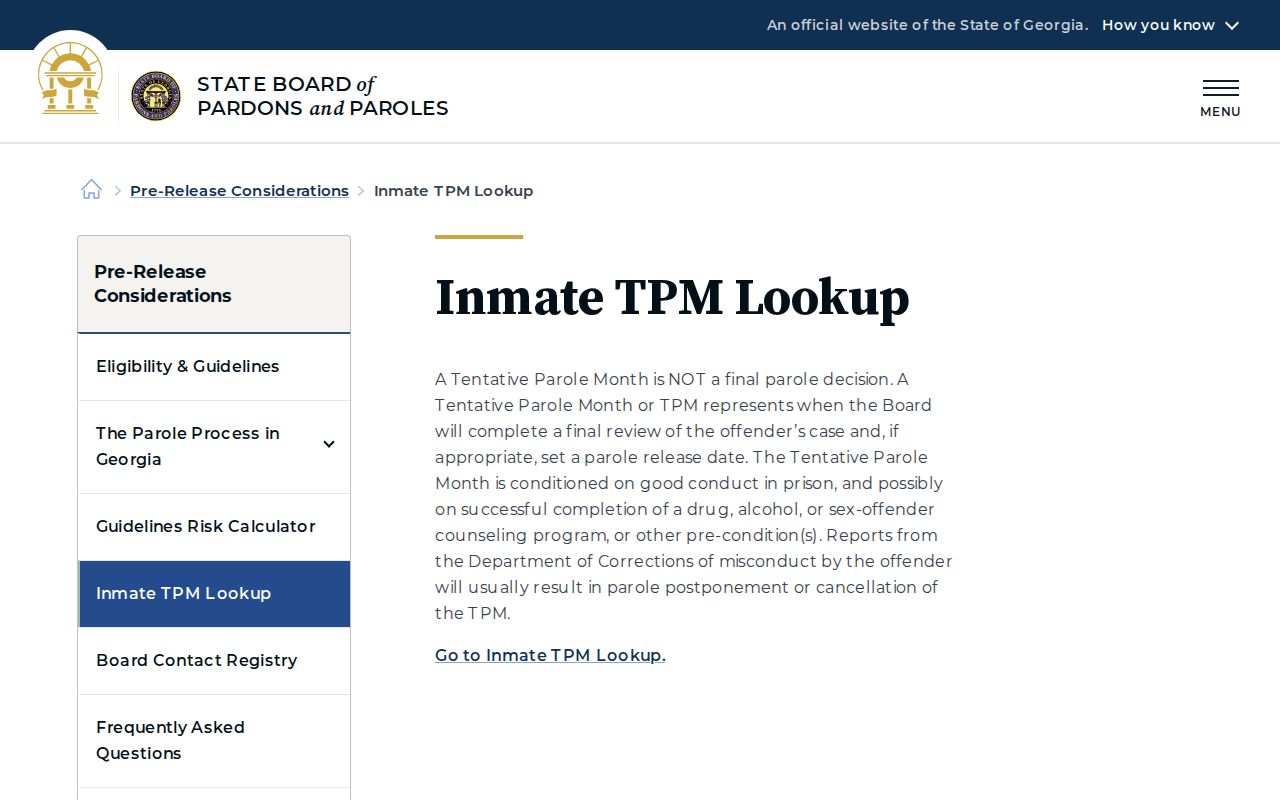
The state page supports the key distinction: a TPM can lead to final review and date setting, but it is not itself a guaranteed Hancock County release date.