
Projected vs Actual Release Date
Four dates are often confused: the date a person leaves Hancock County jail; GDC projected or maximum sentence information; a Parole Board Tentative Parole Month; and a federal BOP projected date. They come from different authorities. A TPM is the month for final Board review and possible date setting, not a promise of release.
A pretrial detainee usually has no sentence-based release date. Bond, a judge’s order, dismissal, a new hold, or transfer can change the path. Ask the jail and court rather than applying state-prison rules.
How to Find a Hancock County Inmate's Projected Release Date
Use the source that owns the calculation.
- Confirm county jail, GDC, federal, or immigration custody.
- For GDC, open Find an Offender and compare identifiers.
- Review active/inactive status, sentence data, and any displayed maximum, projected, or release field.
- Check the TPM lookup separately for parole review.
- For county jail, request the exact sentence calculation from the sheriff or sentencing court.
GDC offers “Released In The Past 15 Days” and inactive-offender filters. Those find a past state release. They do not confirm a local jail departure.
Good-Time Credit and How Release Dates Are Computed
GDC’s Performance Incentive Credit program lets eligible offenders reduce prison service through satisfactory progress in education, treatment, work, and good behavior. GDC materials say eligible offenders can earn up to twelve months. Eligibility and credit can change after discipline or new case information.
The Parole Board says most parole-eligible inmates become statutorily eligible after one-third of the sentence, but parole is not guaranteed. Some offense categories are excluded or have mandatory service rules. O.C.G.A. 17-10-6.1 is relevant to serious violent felony sentences. Offense, sentence date, and crime date control, so a blanket percentage should not be applied.
Why a Projected Release Date Changes
A date can move earlier or later as the controlling record changes.
| Factor | Possible effect |
|---|---|
| Bond or court order | Creates or changes a county release path. |
| Jail credit or PIC | Changes credited service when authorized. |
| Discipline | Can affect credits or postpone a TPM. |
| Detainer or warrant | May cause transfer instead of community release. |
| Parole action | May set, defer, deny, postpone, or cancel release. |
| Sentence recalculation | Changes the agency’s projected or maximum date. |
Hancock County publishes no local good-time, weekend, or holiday release rule. Ask the sheriff or sentencing court for the individual calculation.
Confirming a Release Date
Register through VINELink Inmate Search when the person and agency are covered, then confirm the alert with the custodian. For GDC, compare the inactive record and use the GDC records route if exact verification is needed. For the county jail, request the release timestamp and reason from the sheriff.
The BOP locator is only for federal prisoners. BOP warns that dates may change with sentence recalculation. A past federal release date and no facility location means the person is no longer in BOP custody, not that every other legal status ended.
Hancock Prison Date Sources
The Hancock State Prison page identifies a GDC state prison in Sparta. A person housed there follows the statewide sentence and parole path, not the sheriff’s local calculation. This matters whenever “Hancock County inmate” refers to prison location rather than county booking.
The Parole Board process controls parole consideration, while DCS handles field supervision after release. Keeping those roles distinct prevents a TPM, facility address, or supervision office from being mistaken for the actual release date.
County Jail Date Calculation
A Hancock County jail term may depend on the imposed sentence, jail credit, court orders, holds, warrants, transport, and administrative processing. Research found no official local policy stating a fixed good-time formula or a weekend and holiday release rule. Applying a rule from another Georgia county would be inaccurate.
Ask the sheriff for the current calculation and the sentencing court for the controlling order. Give the full name, booking number, case number, sentence date, and any known credit. Ask whether the date assumes release to the community or transfer to another agency. A detainer can change the destination without changing the end of county custody.
A bond event is not a projected sentence release. The amount and conditions come through the court process, and the person may leave once the required action and jail processing are complete. Magistrate Court handles bonds and pretrial court services locally. Superior Court maintains criminal records.
TPM Is Not a Promise
The State Board of Pardons and Paroles describes a Tentative Parole Month as the point when final review is completed and, if appropriate, a release date is set. Good conduct and required programming may be conditions. Misconduct commonly postpones or cancels the TPM. The Board can change a prior decision up to release.
Georgia’s public parole process is not a simple Hancock County hearing calendar. Monthly public Board meetings address policy and operations, not individual parole decisions. Check the named person through the TPM tool while incarcerated and the parolee search after release. The parolee record may show begin and end dates.
Some prisoners are not parole eligible. Serious violent felony categories, recidivist sentences, life without parole, crime dates, and offense types can control. Use the actual sentence record and current law rather than estimating from a sentence fraction.
GDC Release Record Verification
GDC warns that its public offender information may be incomplete and directs verification through Inmate Records and Information at P.O. Box 1529, Forsyth, Georgia 31029. The public form can filter by name, age, identifying traits, sentence status, primary offense, conviction county, active or inactive status, GDC ID, and case number.
Use “Released In The Past 15 Days” only for a recent state discharge. “Only Inactive Offenders” means not currently incarcerated in GDC, but the individual record still needs review. A projected, maximum, TPM, and actual release date are not interchangeable field labels.
The GDC open-records portal provides a formal path. GDC states that it gives an initial response within three business days, charges ten cents for non-medical copies, and may bill lawful search and redaction time. Exceptions can apply to institutional, medical, investigative, or security material.
Georgia PIC Program Source
The official GDC Performance Incentive Credit page describes the state program used for eligible offenders.
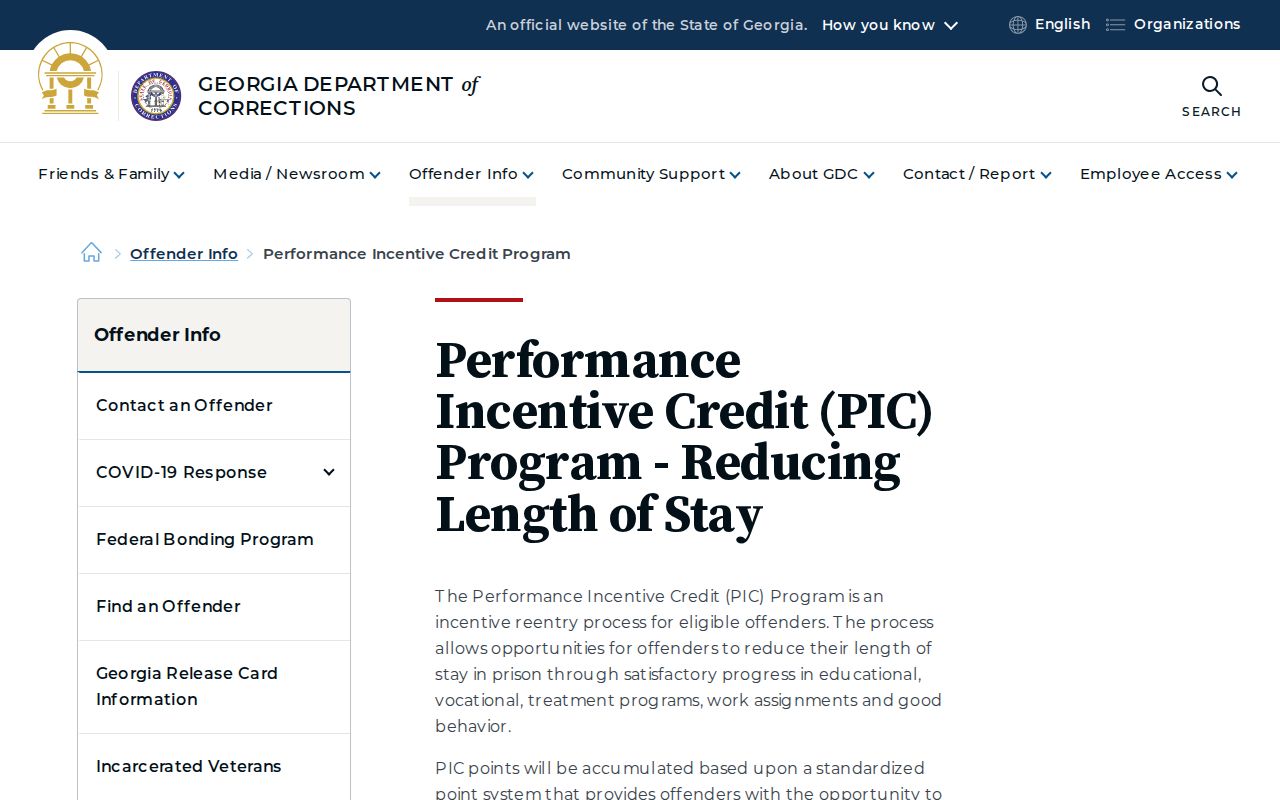
The captured program page applies to qualifying GDC custody and should not be treated as Hancock County’s unpublished local jail credit policy.
Compare Hancock Release Dates
The county jail release timestamp marks departure from sheriff custody. A GDC maximum date reflects the state sentence record. A TPM reflects Board review timing. A BOP projected date applies only to a federal sentence. Put the field label and agency beside every date before comparing them. Two dates can both be accurate because they answer different questions.
For example, a person can leave Hancock County jail through GDC pickup. The local release timestamp closes the jail stay, but the person remains incarcerated. The GDC record then controls prison status and sentence information. Later, a TPM may appear. An actual state-prison release is a third event, followed by parole or DCS supervision when applicable.
A bond release follows another path. Magistrate Court handles bonds and pretrial services, and the person may leave jail while the case remains open. No sentence projection is needed. The court order, bond record, and sheriff release record explain the timing.
Holds Change the Destination
A hold or detainer is a request or legal basis for another agency to take custody. It can prevent community release even when the current sentence or local jail stay reaches its end. Ask whether the displayed date assumes release to the community or transfer. The answer affects how family and personal contacts interpret the date.
Possible receiving systems include GDC, another county, federal authorities, or ICE. Research found no proof that Hancock County operates an ICE detention contract or routine federal holding role, so those paths should be used only when the individual record shows them. A generic quarterly detention report does not establish a person’s transfer.
When a hold is added, lifted, or resolved, an agency may recalculate or update the expected event. Courts can also amend conditions or sentences. The latest official record should replace an older screenshot, printout, or remembered date.
After the Actual Release
Once release occurs, switch from prediction to verification. A county-jail record should show the actual date, time, and reason. A recent GDC discharge may appear under inactive offenders or the recent-release filter. The parolee database can show supervision begin and end dates after a parole release. DCS Milledgeville serves Hancock County for local field supervision.
VINE may send a custody-change alert when the agency participates. Treat the alert as notice to check the official record, not as a sentence calculation. For a federal result, BOP explains that a past release date with no facility location means the person is no longer in BOP custody. Other legal status may still remain.
Keep the projected record and actual record separate. That makes later changes understandable and avoids presenting an estimate as historical fact.